When Venus Met the Crescent Moon: A Rare Celestial Moment in September
by Queen
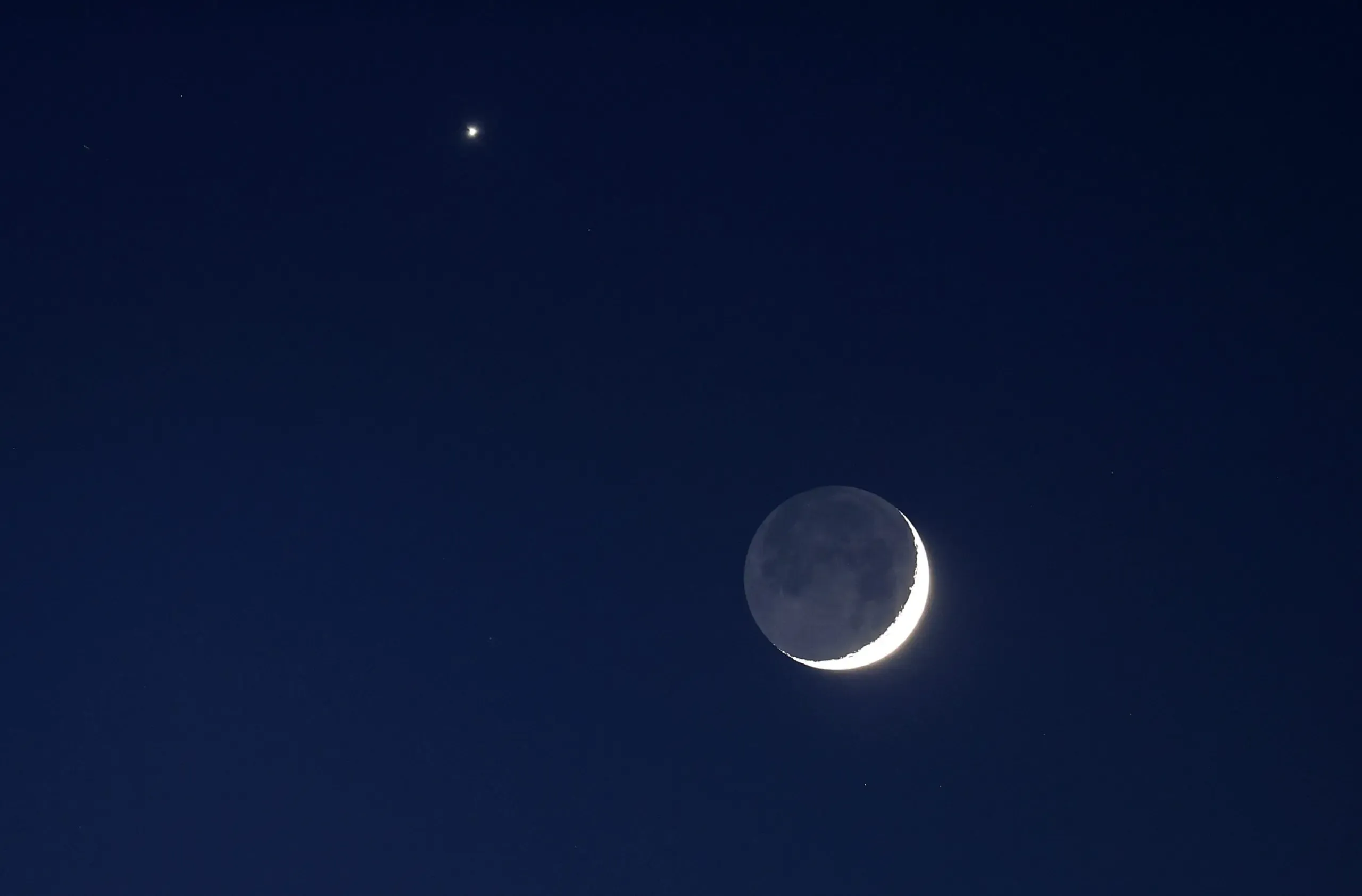
There are evenings when the sky feels less like a backdrop and more like an invitation.
On September 14, 2026, a slender waxing crescent Moon appeared remarkably close to Venus, one of the brightest objects in our night sky. Across certain parts of the world, their paths aligned so precisely that the Moon temporarily passed in front of Venus, causing the planet to disappear from view.
Astronomers call this phenomenon a lunar occultation of Venus.
In parts of Indonesia, including Sumatra, western Java, and a small area of West Kalimantan, observers were within the path of the occultation. Elsewhere, including Bali, the moment appeared as an exceptionally close meeting between Venus and the crescent Moon.
For those who looked toward the western sky after sunset, it was a delicate composition of two familiar celestial bodies appearing almost close enough to touch.
And then, as celestial moments always do, it passed.
What Is a Lunar Occultation of Venus?
A lunar occultation occurs when the Moon passes directly in front of another celestial object from our perspective on Earth.
On September 14, the Moon moved across the apparent position of Venus. The overall occultation was visible across parts of Asia, Africa, Europe, and western Russia, although what people experienced depended entirely on where they were standing on Earth.
The Moon itself was only around 12 percent illuminated, creating the fine crescent that made the encounter especially striking. Venus was also shining brilliantly nearby.
In Bali, the Moon was in its waxing crescent phase, while Venus remained visible in the evening sky after sunset. Scientifically, it was a meeting of orbital movement, perspective, and extraordinary precision.
Yet understanding astronomy does little to diminish the beauty of simply witnessing it.
A Moment That Asked Us to Look Up
Much of modern life keeps our attention directed downward. Toward screens, schedules, messages, and the small urgency of whatever comes next.
Then the sky gives us a reason to look elsewhere. A crescent Moon beside Venus. An unexpected alignment. A quiet reminder that the world continues moving through rhythms far greater than our own routines.
Perhaps this is why celestial events have held human attention for thousands of years. Astronomy explains how these movements happen. Cultures and traditions around the world have also found their own meanings in the changing sky.
The two do not need to compete. Sometimes it is enough to understand the science while still allowing ourselves to feel something when we look upward.
For those who enjoy reflecting on the symbolic language associated with the sky, the crescent can suggest beginnings, transition, and gradual emergence. Venus, meanwhile, has long appeared in human mythology and storytelling as a symbol connected with beauty, affection, creativity, and harmony.
These interpretations belong to culture rather than astronomy.
Still, seeing Venus beside such a young Moon created an image that almost seemed designed for contemplation. No interpretation was necessary. The act of noticing was enough.
Bali Beneath the Evening Sky
Bali has always invited an awareness of natural rhythm. Morning arrives through changing light over rice fields and tropical gardens. Afternoon heat slowly softens. At sunset, the sky transforms again before the island enters the quieter cadence of evening.
Nature continues to tell time here. A celestial event becomes another part of that conversation.
Perhaps that is what makes moments such as the Venus and Moon encounter especially beautiful. Wherever we happen to be, looking upward briefly places us within the same larger landscape.
Carry the Feeling Into an End of Year Escape
As the final months of the year approach, there is often a natural desire to slow the pace.
Not necessarily to retreat completely, but to create enough space to notice what may have been overlooked during a busy year.
Inspired by this spirit of pause and reconnection, the Blue Karma End of Year Escape invites guests to experience Bali across our three distinctive sanctuaries, Blue Karma Dijiwa Seminyak, Blue Karma Dijiwa Ubud, and Blue Karma Village, with up to 30% off the Best Available Rate across all room categories for eligible stays through December 25, 2026.
As the year moves toward its final chapter, discover your own rhythm in Bali with the Blue Karma End of Year Escape, across Blue Karma Dijiwa Ubud, Blue Karma Dijiwa Seminyak, and Blue Karma Village.
Stay a little longer. Look a little closer. Leave space for something unexpected. Secure your stay now!